Album: Buy
Contort Yourself
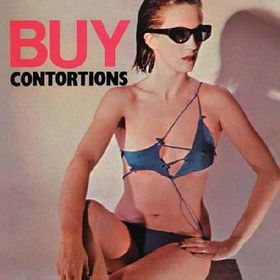 The killer bass line sucks you in and James Chance's deranged vocals and atonal spaz sax spit you out. It's equal parts Ornette Coleman-style free jazz, New Wave inspired propulsive rhythm section, and mutant art installation. A winning combination.
James Chance was one of the foremost members of the New York "No Wave" scene of the late 70s and early 80s. The "No Wave" movement does not really imply a musical style; the term encompasses a wide range of artistic media. It is perhaps best thought of as a philosophy, or even more simply as a temperament. Underground musicians, artists, and film makers responded to the burgeoning commercialism of the New Wave and punk scenes by making art that was deliberately provocative and anti-commercial. The music tended to incorporate fundamental elements of New Wave style which were then ground into grit by the abrasive surface.
I find the spirit of this rebellion quite courageous and thrilling. And necessary in a healthy artistic environment. But, it must be said, I don't always find the music all that much fun to listen to.
"Contort Yourself" rocks, however.
And a fun fact: Chance also recorded as "James White" and under this name released "Contort Yourself" as a quasi-disco track. It didn't sell.

Loved the tune. Has that abrasiveness I desire in my music. Also, I find it funny that they are trying to undermine punk and new wave by being anti-commercial, when I thought that was what punk was doing to other mainstream genres of music. Hehe.
ReplyDeleteYeah there is a certain irony there. :) Punk was becoming more mainstream though. Some might even argue that as soon as Malcom McLaren got his hands on Johnny Rotten and the boys punk began to sell out.
ReplyDeleteThere are really interesting artistic precursors to the No Wave movement. LaMonte Young, a New York composer from the 50s-80s, was a big influence, for example. You should check out his music.
"I find the spirit of this rebellion quite courageous and thrilling. And necessary in a healthy artistic environment. But, it must be said, I don't always find the music all that much fun to listen to."
ReplyDeleteSo, wait... you admit, then, that enjoyability is important, and possibly more so than what the music is attempting to do? :-P
I haven't gone back and read the comments after me on the Lightning Bolt post, that Kris showed me, but I'm getting there. I get to go through you blog in fits and spurts, but, I've started always enjoying it, even (yes! :-P) when I might not enjoy the music.
An anecdote: when I was in the first half of my undergrad career, I took most of a music minor (modal counterpoint got dropped because I had overloaded myself, and it was the least enjoyable of five courses--the professor had horrible allergies, and snorted and blew his nose through every single lecture). I took the basic second year composition course, that focussed on atonal art music of the 20th century. I think the only thing I actually learned was that I didn't like Ligeti nor John Cage. I still don't think the semester was a waste, though.
Hey, I like Lightning Bolt because I like Lightning Bolt, not because it represents a critical shift in musical perspective. Doesn't mean I'm not discerning. :)
ReplyDeleteThanks for the kind words about the blog, I appreciate it!
As for the 20th C composition class, that's very cool. If you don't like the conceptual Cage, you might try his more accessible works like his pieces for prepared piano, or his early string quartet. I'm particularly fond of the latter. As for Ligeti, yeah he's an acquired taste for sure, but I really love his work. You might try his etudes for piano (http://www.youtube.com/watch?v=YXm36LwVWCU&feature=related). Or watch Kubrik's 2001: A Space Odyssey and revel in his "sound mass" compositions (http://www.youtube.com/watch?v=JnuAaKiX1sg).
What 20th C composition did you like, btw?
By the way, here is a link to the Cage string quartet:
ReplyDeletehttp://www.youtube.com/watch?v=3c-pWFFrcNY